Sunshine, the soft air of Spring, blossoming plum trees, cherry trees and Blackthorn are all behind me as I head to Manchester, the first leg of the trip. The ultimate destination being Blackburn, a name synonymous with the pioneers of professional football.
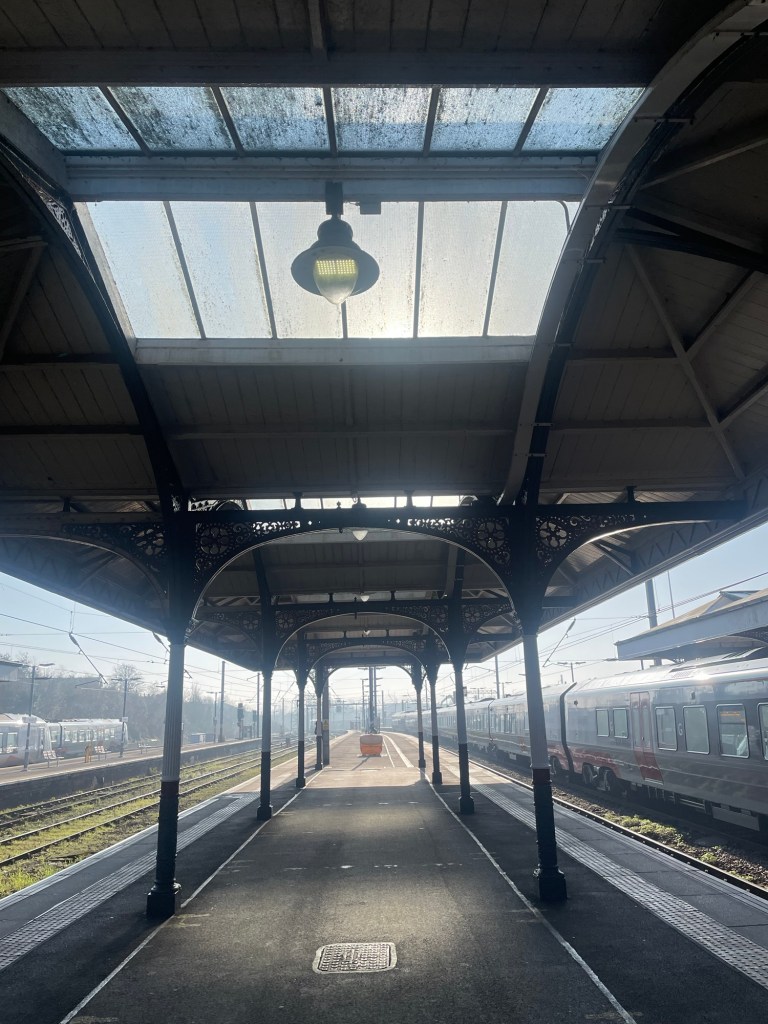
Waiting for the decrepit, two-carriage dirty diesel of the privately run East Midlands Railway, there was a noticeable warmth standing in the sun, but still unpleasantly cold when waiting in shade. How EMS have been allowed by the Rail Regulator to continue to operate such a small capacity, filthy-fumed service, connecting Norwich with Liverpool, via a series of substantial towns and cities, underlines the market failure of the privatisation of public utilities.
With long-established university towns along the route, including Norwich, Nottingham, Sheffield, Manchester and Liverpool, adding two coaches at Nottingham is a token gesture. The seats are wearing thin, lumpy and uncomfortable. The carriages have minimal luggage space. The old diesel engines thrum noisily. The rolling stock shakes and rattles as the train lurches westward. The train is full.
Passengers sort themselves out once the doors allow us in from the cold. Those who prefer to face forward and those who feel more at ease with backs to the direction of travel, are put into a commotion when the train pulls into Ely, then reverses out as it negotiates the major junction. There are always anxious passengers needing reassurance that all is well when they realise the train is moving in reverse out of the small fenland city.
Eventually, the long curve begins to curl away from the Norwich branch. The Great Ouse flows on the right-hand side and an expanse of low-lying land extends to every horizon. At this time of year the fields are bald, crops have yet to break through the soil, which is peat-black for miles. In some fields herbicide has been applied to unwanted grasses, which are turned yellow. Near Burnt Fen, one drain appeared as yellow as the poisoned leaves in the field above. It flashes by, which made me doubt what I had seen. Were I cycling, I might have paused to photograph the yellowed standing water and reported it to the Environment Agency.
Flooding is extensive. The dykes run between high embankments, which contain the inundations. For field after field there is water. I understand that some farmers have had to write-off significant tracts of land because of the persistence of the flooding.
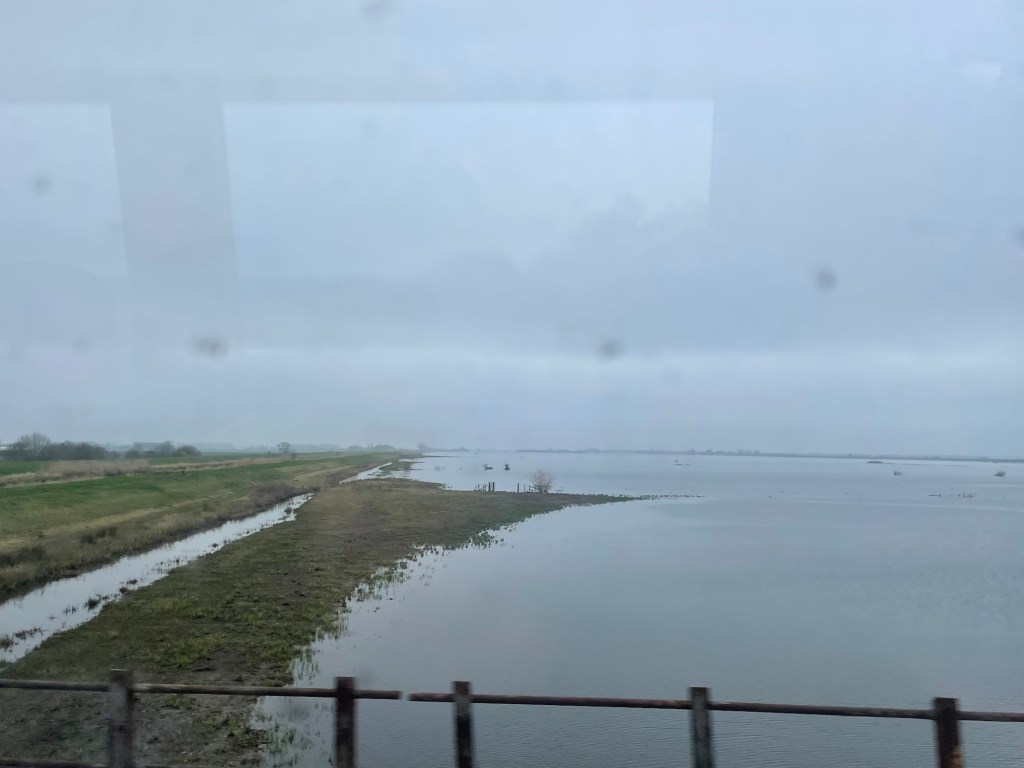
This is The Fens, a naturally occurring marshland, drained by Dutch engineers in the years following the crowning of James I in 1605 CE. As a result of the drainage work the region became greatest source of wheat, barley and sugar beet for England. Now, the symptoms of climate disruption, extremes of drought conditions, then periods of intense and prolonged rainfall, have brought significant changes to the land here. On the face of it, The Fens may be returning to their natural, pre-agricultural state of marshlands, inhabitable islands and seasonal harvests of waterfowl, molluscs and fish.
The flat topography of The Fens has great value to the UK as a location for solar power generation, when there is sufficient sunlight. Additionally, the notorious cold, easterly winds that sweep the area are uninterrupted from the moment they cross the North Sea coastline, so East Anglia is home to the occasional wind turbine. Investment in modern on-shore wind power technology in the UK is far less than seen in low profile Picardy and Pays de Calais, at least here, where arable farming predominates.
Historically, the east of England was an early adopter of wind power. Robert Louis Stevenson noted how spectacular this side of the country’s windmills appeared to him, as he travelled through on first leaving Edinburgh. Today, he may well have remarked on how much of potentially productive soil is shielded by solar panels. Whichever way East Anglia generates electricity, the area is criss-crossed by power cables, looping from pylon to pylon.
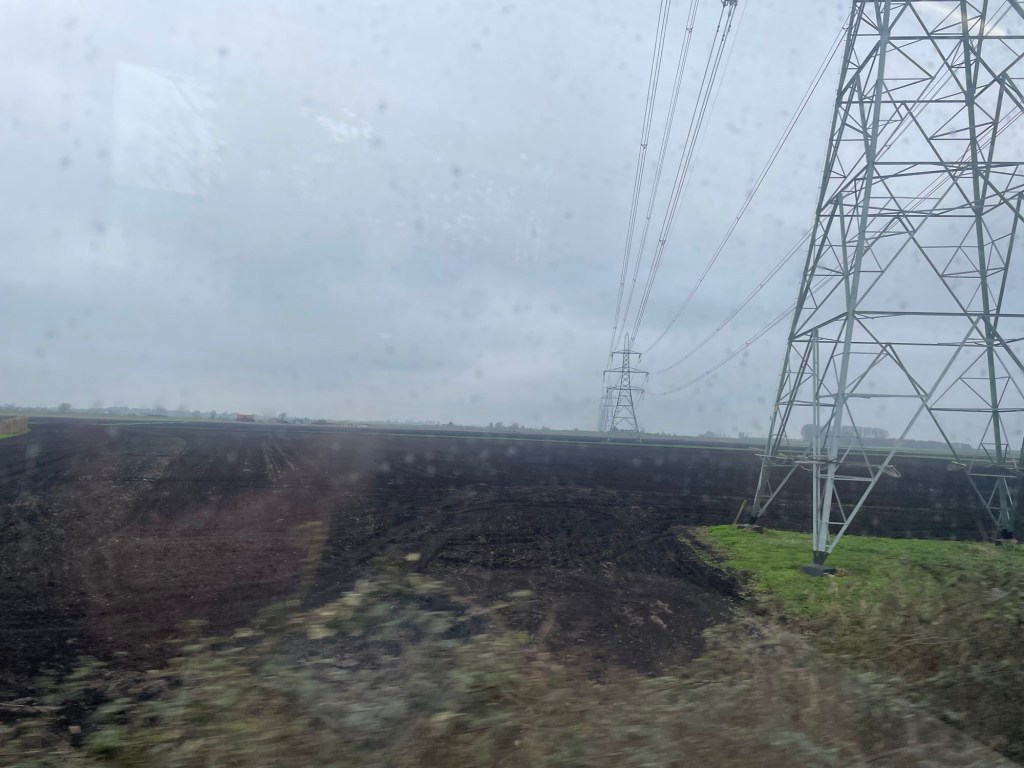
A more recent power distribution network, bringing electricity inland from the new off-shore wind farms, is being channelled underground at considerable cost.
The land to the west beyond March has proved productive in other ways. Between the small market town to the cathedral city of Peterborough, the earth has been quarried for material necessary to bake building bricks. The land has been excavated to tens of metres deep. Enormous diggers and dumper trucks are deployed to drag the clay to the surface. The chimneys of the remaining brick ovens still emit plumes of smoke, I presume filtered smoke , with the worst polluting particles removed. Locals can still identify from their kitchen windows the wind direction from the trail of smoke over the countryside.
After crossing the Nene on the southside of Peterborough, the diesel runs alongside the express trains on the East Coast Line. The land is still quite level, but woodland is more common. The Great North Road, more commonly known as the A1(M), with its unending cavalcade of motor cars and HGV trucks, is visible about half a mile to the east.
The land begins to undulate and is better suited to cattle and sheep farming.
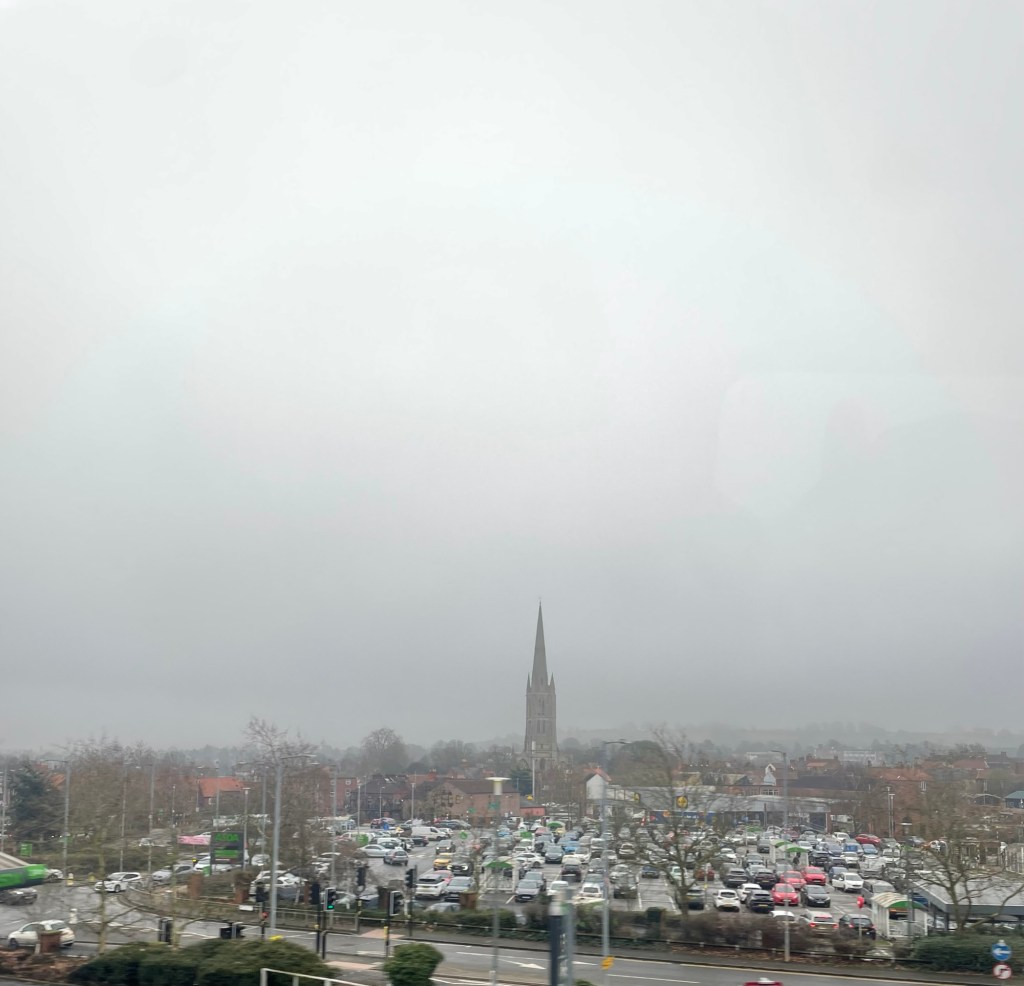
The needle-like spire of Grantham’s St Wulfrum’s marks the point where the route enters the East Midlands. Green hills, stone houses, dark-red brick terraces of houses line the sides of valleys, in which stand old factories. These mills and manufactures were powered by water and then steam power. Narrow industrial chimneys poke here and there above the townscapes that nestle between the rounded hills.
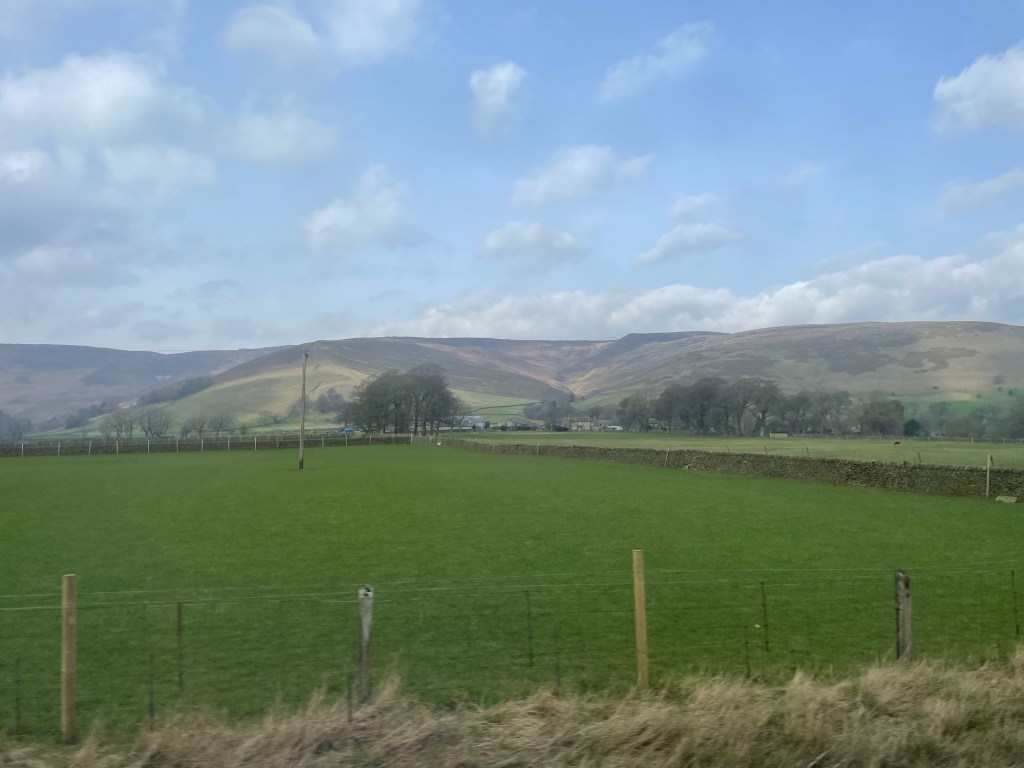
By Sheffield the hills visible from the train are substantial. The train line follows river valleys, runs adjacent to canals. Small towns flash by, become smaller still as the sharp inclines and barren soils of The Peak District border the route. Tunnels suddenly turn the carriage windows to mirrors, encouraging some passengers to turn and look around at their fellows. Many seem oblivious to the immediate world about them, engaging instead with a mobile phone-sized screen that is connecting them to places further away than the cottages and terraces of Hathersage and Bamford, just a couple of hundred yards beyond their seats.
None of the good weather has travelled with us from Norwich. By Manchester, the temperature is falling. Sunglasses offer no benefit and the sky suggests rain is likely.
I have managed to arrange my journey so that I can catch up with a long-standing friend from my student years. As I step from Manchester Piccadilly Station, I spot him reversing into a parking space. With no hanging about for either of us, I jump in and we head toward his home in Prestwich. We will be watching England’s cricket team trying to chase down India’s score of 253 – 7 in 20 overs, talking about life, as well as heading into the local high street for a pizza.
CLP 05/03/2026
 Journey of Words