
Woken by heavy rain to a miserable grey sky, I opened the window to let in some air. The honks of a pair of Canadian Geese heading toward the Rochdale Canal echoed around the steep garden. A Jackdaw called out as it flew over the house. When rain ceased, the chirping of sparrows added a brighter tone to the morning.
After breakfast, Seán and I headed up the road, passing the new houses opposite, then the warehousing and distribution depots that have filled in the space once occupied by a tyre factory. Operated by Dunlop Tyres, the extensive old works ran next to the country’s first railway line to cross the spine of England, The Pennines. Castleton railway junction would have been busy carrying supplies in and products out.

The factory was a significant employer in the town, but it had a lot of competition for workers. Housing was built close to the factory and my host’s family home was built to a design felt suitable for middle managers. Whether terraced properties were built by the tyre company, or any of the many mill owners, I don’t know. The Arrow Mill, across the canal, behind the factory site, is enormous. Arrow would have employed many workers on several machine floors.

Two Januarys ago, Seán and I had walked the canal to Littleborough. It had been snowing then and the temperature was below zero when we headed out. The frozen canal, dusted by snow was quite beautiful then, today less so and only marginally warmer if not sheltered from the wind coming off the hills.

We made our way along the slightly sticky towpath, standing aside for cyclists, three women joggers and a few bikes. There were one or two dog walkers taking advantage of the break in rain. Early signs of spring were apparent, but not enough to declare that spring had reached the Roch Valley. Somerset was well into the season of hope, Norwich has broken the back of winter, Lancashire is well behind.
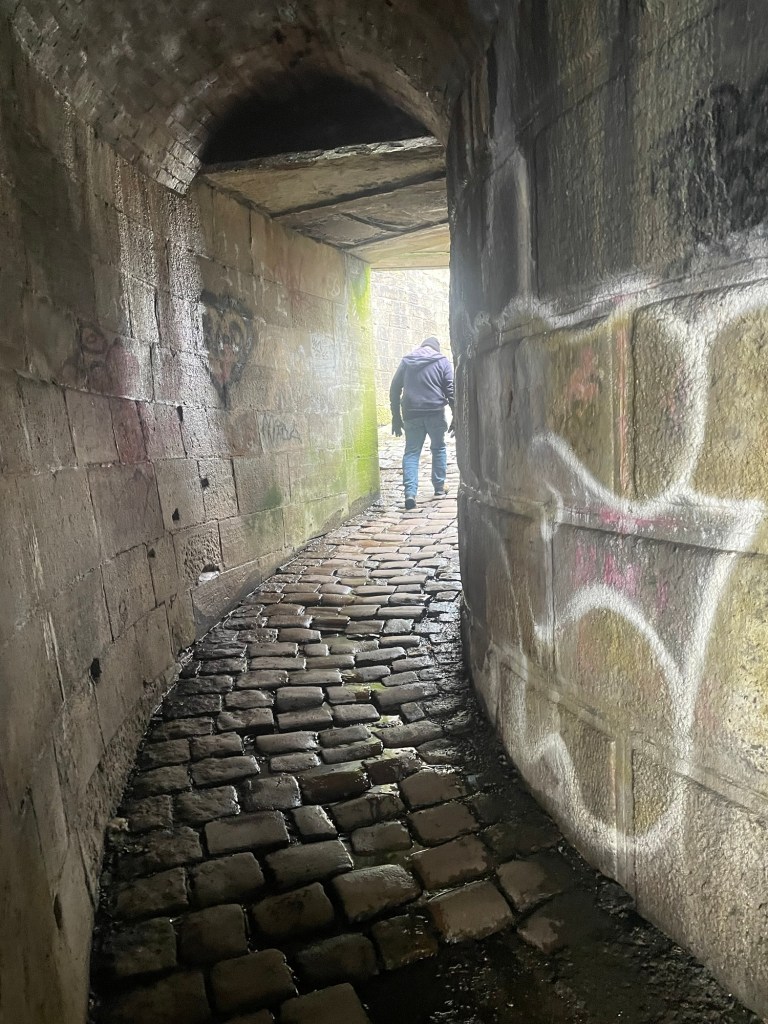
At Littleborough, we completed a quick tour of the pubs, The Red Lion, The Falcon Inn, The Queens, finishing at The Wheatsheaf.

The Red Lion had a real end of the working week feel to it. Tradesmen and labourers were gathering, straight from their respective jobs, to swill out the dust from their throats. A game of pool was being expertly played by two retirees, one in shorts, showing off his Costa Brava tanned and tattooed calf muscles. His whole demeanour suggested a surplus of having disposable cash and being time rich. It was if he’d come to the pub at this early hour to display the rewards of a well-financed retirement to the workers. He had obviously spent a fair bit of time honing his cue practise.
The Red Lion is a well-maintained pub. It has four rooms to drink in, one of which could be used for private functions, panelled off from the bar, behind the lounge. The public bar took the corner nearest the road. The games room was the back bar. It had a well-stocked trophy cabinet on the far wall, cushioned bench seating around the walls, with regularly placed push buttons, that Sean told me would have once been bells, used to call for table service from the bar staff.
The Horse Shoe, was once a pub too, but now operating in a different business category, still stands tall in the town, its name indelibly carved in stone.
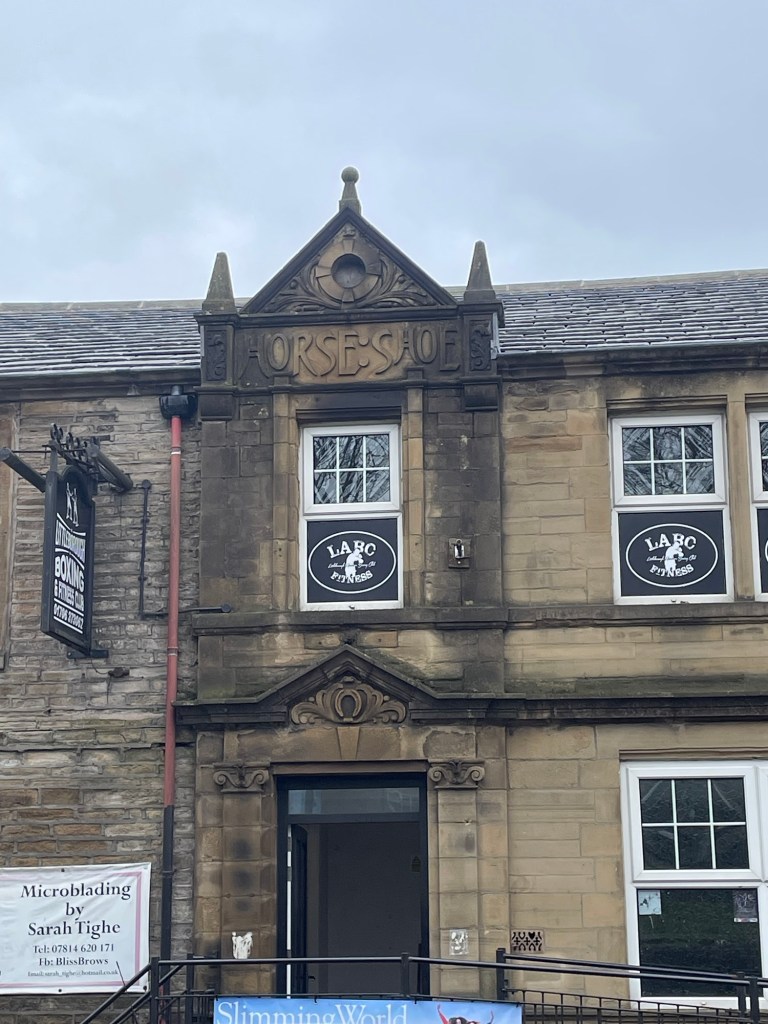
There are other substantial buildings in the town, which were clearly former pubs, taverns, or coaching inns.
The Falcon Inn was quite busy and much more welcoming. The clientele appeared to have spent a significant part of the day camped in the extensive bar. It felt as if the working week had not been a particularly challenging experience for some of those present in one end of the pub, but at the other end, tradesmen had their own corner. There was even a smart couple passing through, dressed as if for a Big Night Out in either Leeds, or Manchester, the extreme of choices offered by the train service.
The Falcon Inn is across the road from the war memorial that lists the Pals’ Battalion that came from this small town.

I have written specifically about this memorial before. Littleborough lost many men in the First World War, families of men, up to six shared surnames en bloc. It is a shocking roll call. The distress and hardship families of the town must have endured as a consequence is unimaginable.
I spoke to a man known as Alty, a sociable character, about this. “Those are our families.” he underlined.
He asked, “Have you served yourself?”
Teaching does not qualify as serving in the forces, whatever myths about modern schools the tabloids promote. This chap had done his time in uniform in the Royal Engineers. He named most places of conflict around the turn of the century.
I asked if he had done mine clearance, he simply said, “I’ve done all sorts.”
On parting we exchanged names and shared a firm handshake.
I persuaded Seán to try The Queens. Again, workers collecting for end of the week beers. It was a little less cheery, more weary.
Seán was not comfortable in this pub. We left after a swift pint.

The bar-woman in the Wheatsheaf turned out to have been born and brought up in the same postcode area to me, although on the other side of the tracks of the railway town, Eastleigh. She had even been for a spell to one of the same schools as I had, Barton Peveril.
She was a right character, full of energy and good humoured chat. Her husband was once in the military, so she’d lived and done bar work in West Germany, as was. When she said she was still in her early 50s, I was surprised. Her appearance underlined the toll working behind the counter takes on bar staff. I had thought she was more my vintage, but she was more than ten years junior.
After ticking that one off, it was time to catch the train back to Cassie. That ride took about eight minutes.
~
CLP. 11/03/2026
 Journey of Words