There's a lot of sky in East Anglia. It offers plenty of sunshine, wonderful cloudscapes and very little protection from the wind, which came from the north-north-west today.

Buffeting, gusting, persistent. Difficult for me to walk in, far trickier for birds to manoeuvre in, except for the more cavalier and specialist varieties.  Jackdaws were having great fun, kestrels were in their element, gulls were enjoying the speed and fuel economy afforded by the conditions.

Travelling into Sheringham by train is great if the dainty seaside town is your final destination.  Should you wish to travel further along the coast, westward toward Cley-Next-The-Sea, Blakeney, or Wells-on-Sea, the Coasthopper bus, CH1, will have left a couple of minutes before the train from the city arrives. At least that gives time to nip into the bakery and grab a bun, before the next bus is due.
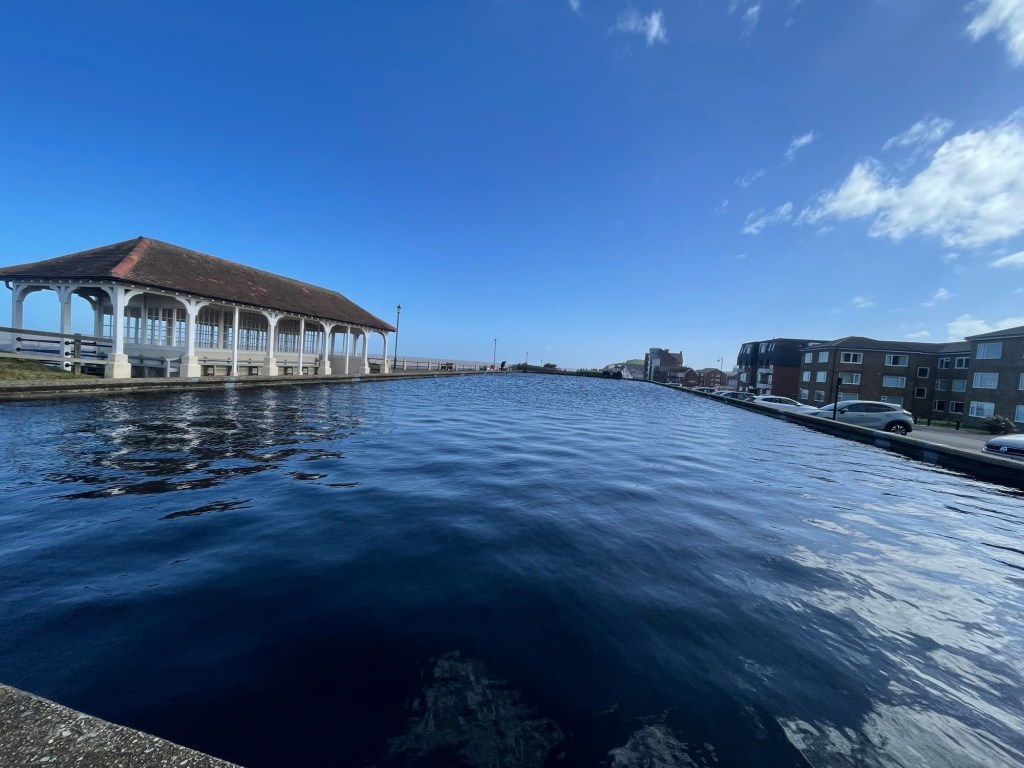
An ornamental pond, Sheringham
On reaching the bus stop outside the lawn bowls club, I found out that the winter service, meaning once an hour, was still running.  Not wishing to stand about for three-quarters of hour in the blowy conditions, I headed up the road. I have walked the route to Salthouse from Sheringham before. The last time was around the time of the pandemic, so I knew it was feasible.

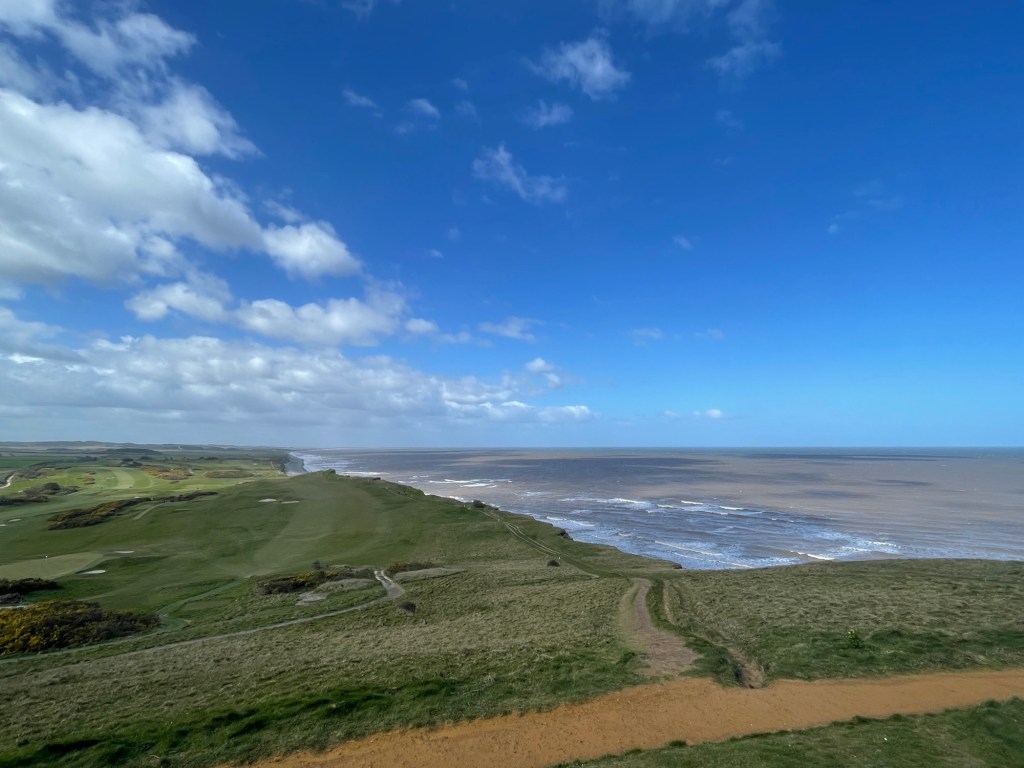
Head west out of town and you will see the entrance to the local golf links.  Cross over the railway, then as you enter the club grounds, turn to your right and you are allowed to skirt the practice area to the official Norfolk coast path.

With Holy Week well under way and the Sun out, the golf course looked busy. It must be one of the most beautiful settings for the game anywhere in the world.  Bedford School golf team were just getting out of their minibus for some kind of match, as I walked by.  For middle-Englanders, the young players were about to have an education in links play. The dramatically undulating ground and the stiff breeze coming off the sea were likely to provide a challenge to golfers used to low lying, flat turf. There are very few trees at Sheringham, but lots of long rough grass to while away the time searching for wayward shots. The fairways look broad and there are few obstructions to lines of sight, but even so, not a course for novices.
I am not a fan of golf. Oscar Wilde described the game as a good walk spoiled. I agree, but if it gets people out in the fresh air, that's ok. I noticed that the American professional golfer, Tiger Woods, has had another Driving Under the Influence charge brought against him. I suspect nearly every golfer in the world, has at some time thought, there but for the grace of God, go I. The 19th Hole, (the bar where drinks are taken following a round of gold), is a notorious tradition at many clubs.

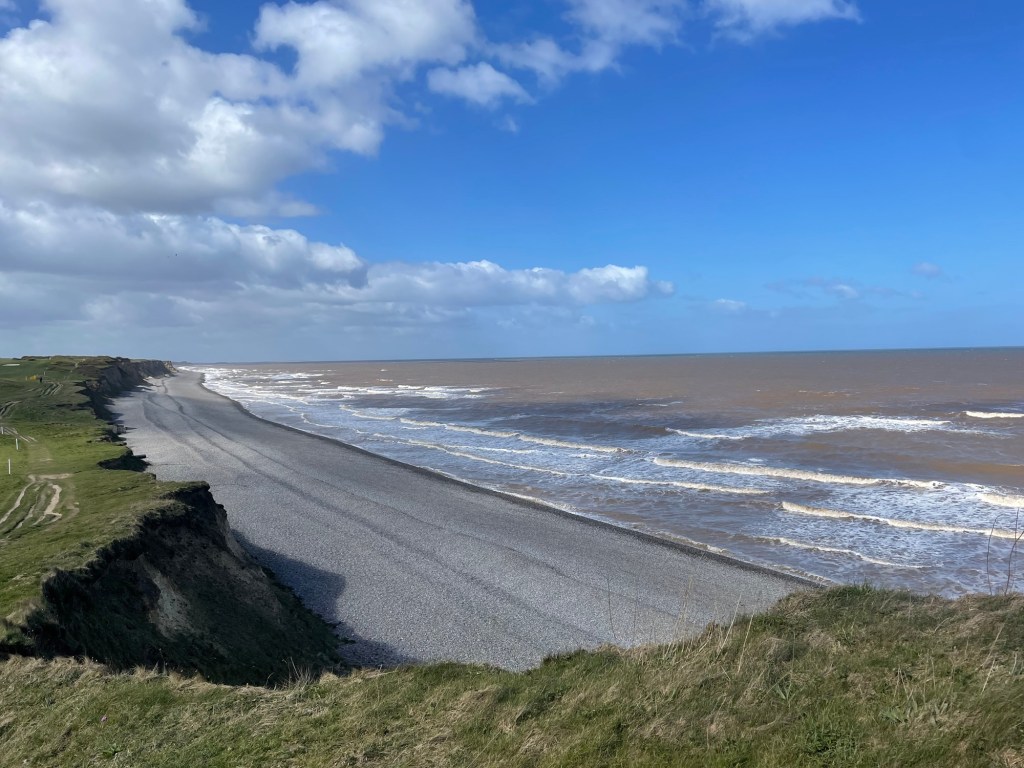
The Sheringham course is being eaten into by the North Sea. It's situated on sand and clay, a geological mix that offers little resistance to the pounding waves.

The cliffs are soft. They slump without notice and leave sharp drops. The coast path is being pushed further into the golf course tide by tide.
There is a point where you can safely clamber down to the beach from the path. It is just a couple of metres down and does not involve any of the cliffs. Never try to go down the cliffs here. A cliff collapse is highly possible due to water coursing through underneath, so being covered by the sand and clay and a suffocating death is on the cards.  You would risk joining the fossils of mammoths and other pre-historic creatures under any cliff collapse.

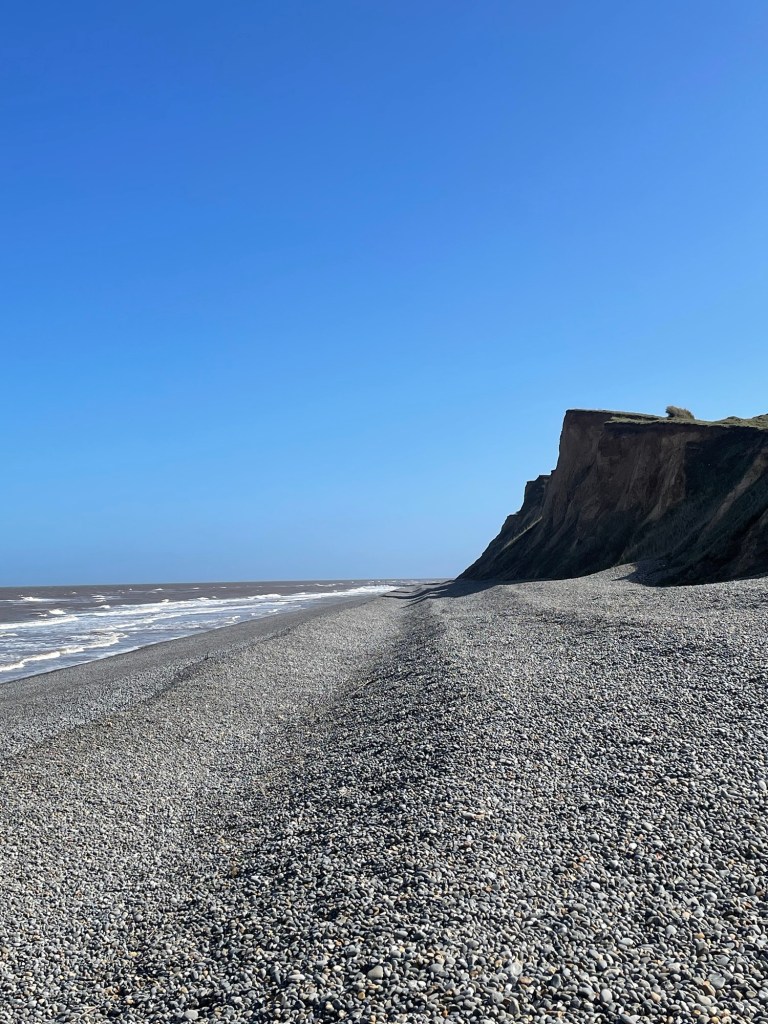
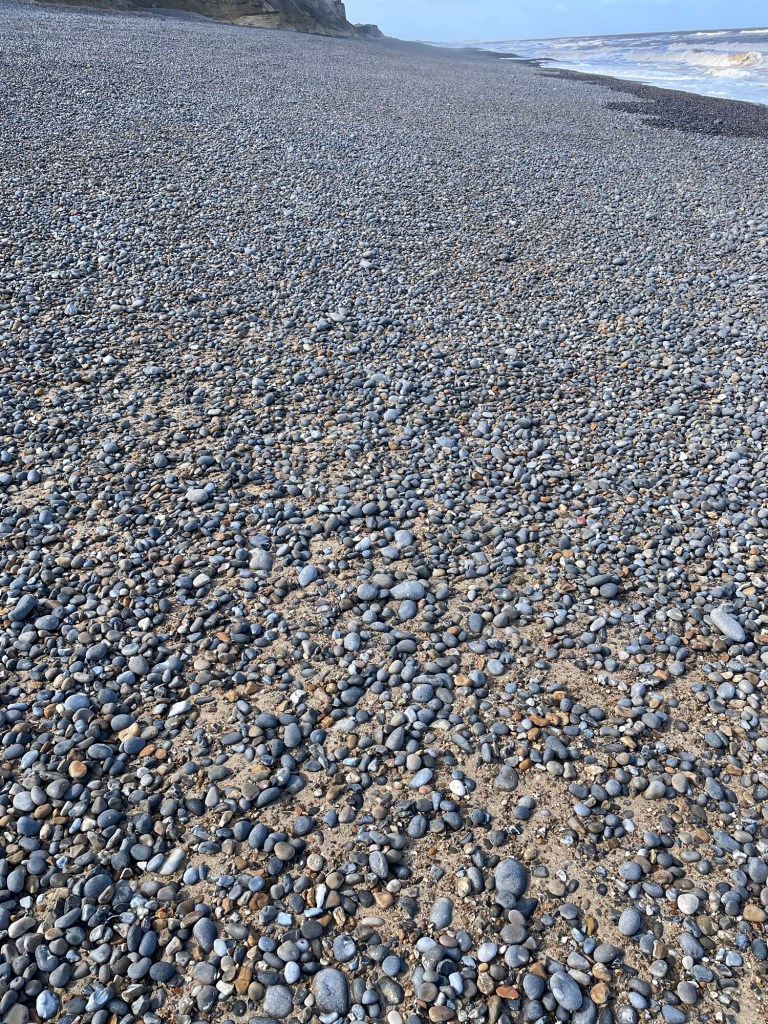
At this time of year the tides are at the extreme. The beach is made of shingle and until the tide runs out on a calm day, no sand is to be seen. The stones are steeply banked, with three distinct levels visible today. From top to bottom of the beach, I estimate that the fall is about six metres.
The easiest walking is where the tide washes up and back on the lower shelf. This is generally the most gently sloping terrain, sometimes revealing sand below a scant pebble covering. This is a welcome relief for the legs and feet, which are asked to traverse substantial, rounded pebbles which roll and slip underfoot at every stride. This is hard, hard walking, but the crunch and rattle of the stones in the rhythm of steps is wonderfully musical.

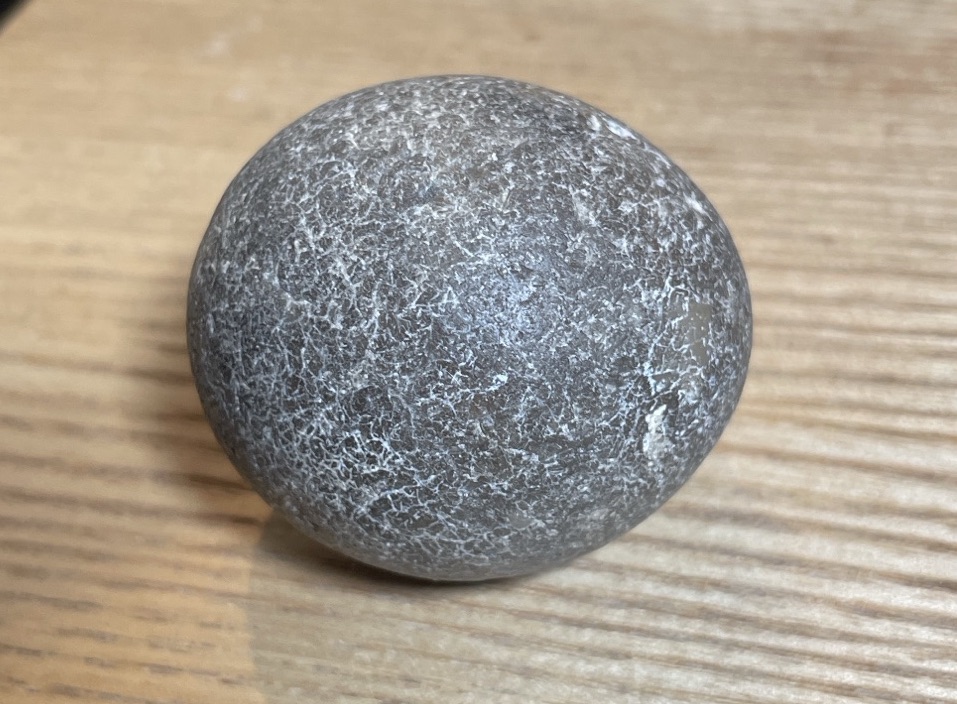
No one else is at beach level today. I have fives miles of  beach to myself. The wind and sloping, rolling shingle make it difficult to walk in a straight line.  As I march on, I scan the pebbles looking for novel shapes, patterns, colours. I am particularly keen to find sea urchin fossils. I have one at home, so smoothed by wave action that it is easier to know its origin by touch, than sight.
It measures roughly 2.5cm in diameter and is heavy for its size. Today, I pick up some odd shapes and interesting patterns. I discard a few, take home a few for my large glass bottle, which is slowly filling with bits from the seaside, as long as they can drop down the bottle's neck.

The wind is as cold as it is strong, but under my light rain-jacket I am getting hot from the effort of the trek. The wind is in my ears, the waves breaking on the shore and rolling the pebbles, my footsteps across the shingle provide the ambient sounds to my journey. Cutting through this noise, I can still hear larks singing somewhere just inland from the cliff edge. A pair of Oyster Catchers lift off just ahead of me, their shrill piping alarm calls clearly audible.
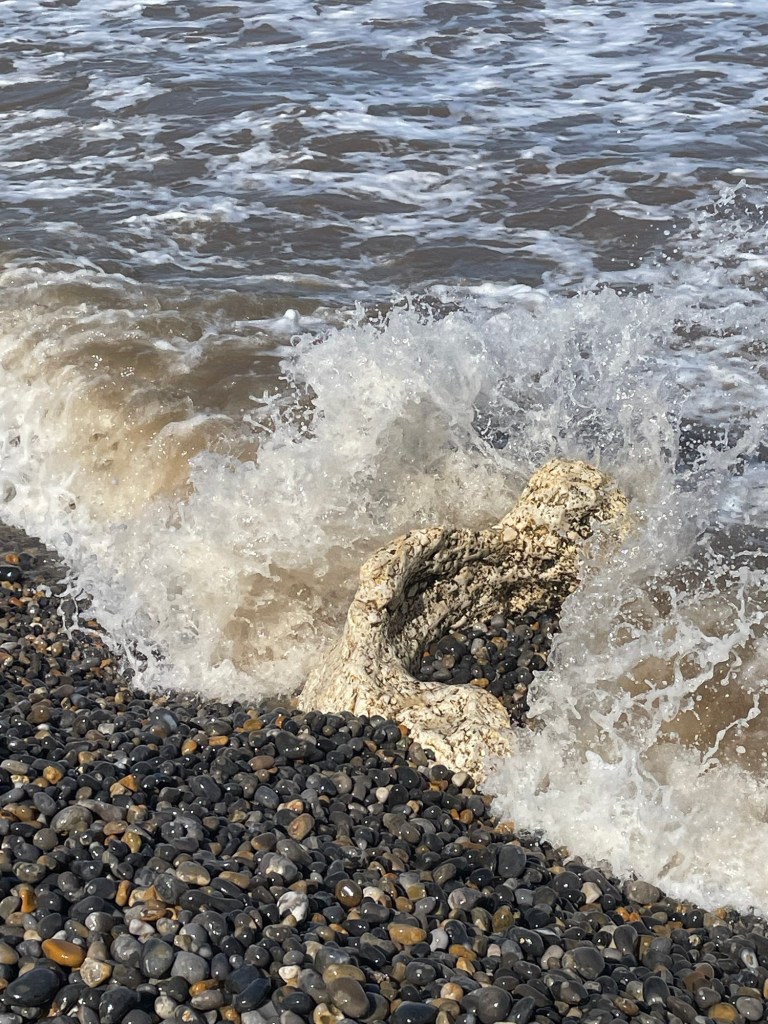
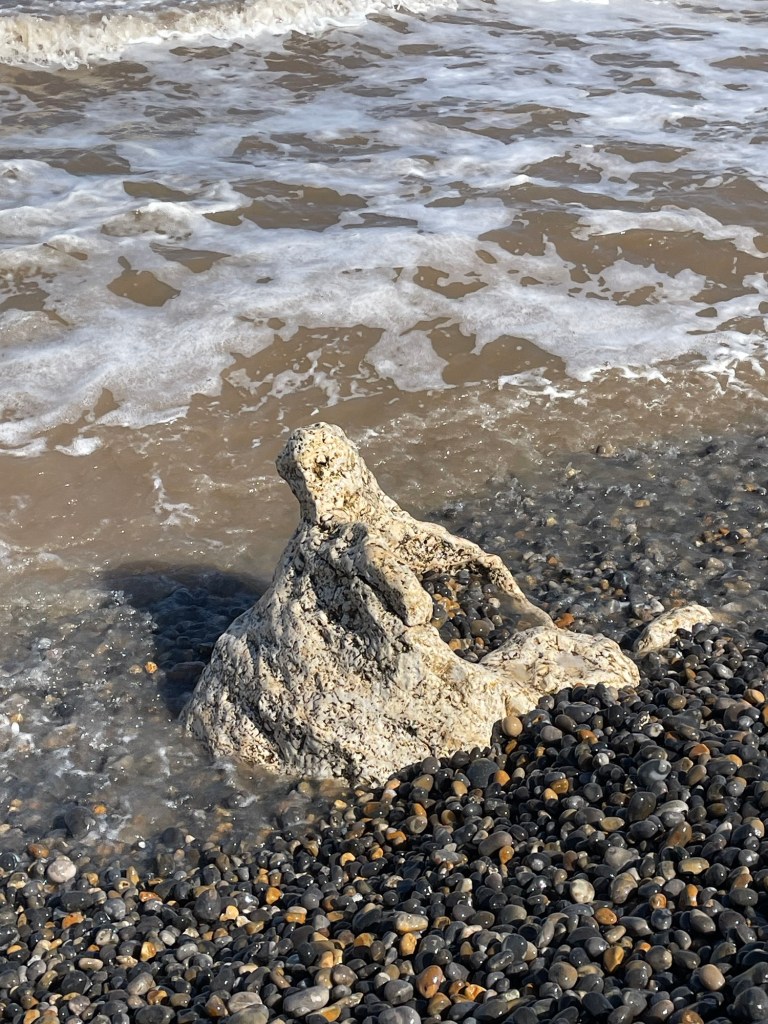
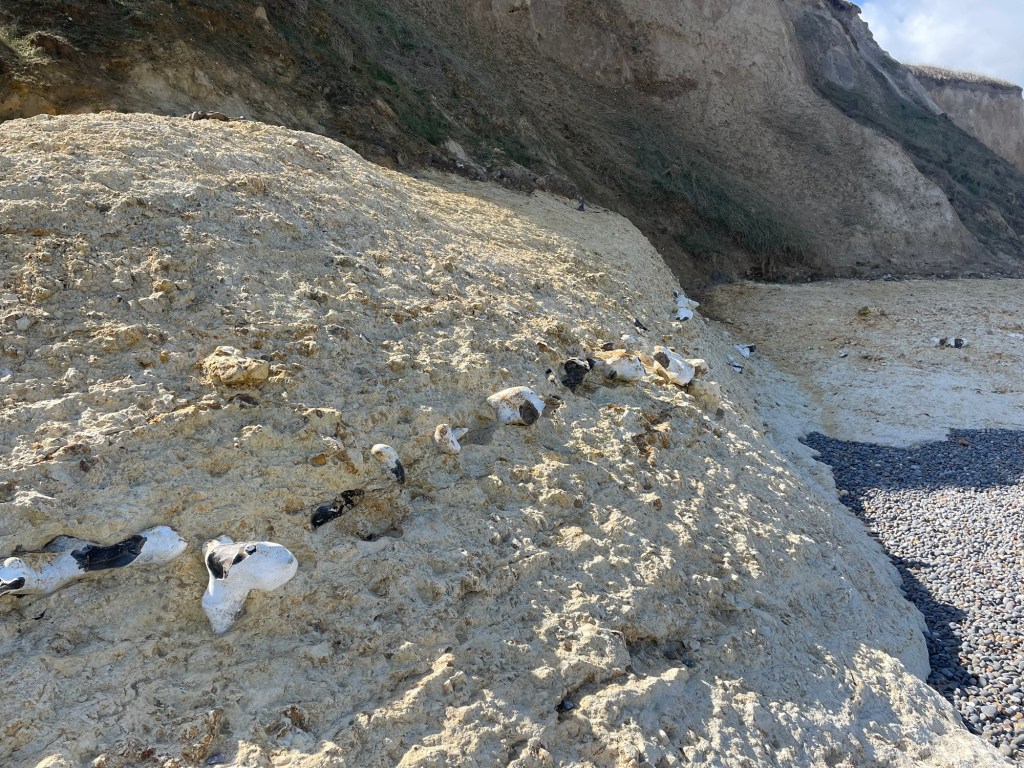
My eye is drawn to an unyielding block on the waterline. Unmoved by the breakers. I thought it manmade, possibly a piece of concrete from a coastal defence bunker. When I got closer, I was less sure of its nature.

It had a bowl shape, in which small round stones had collected. The side meeting the brunt of the waves was curved, with a snout pointing out to sea. It was not modern concrete. The form showed no sign of weakening from the battering it was getting.
Intriguing as it was, I moved on. I do not need to know the answer to everything anymore. I am still curious, but have decided in the recent past to accept not knowing some stuff is okay.

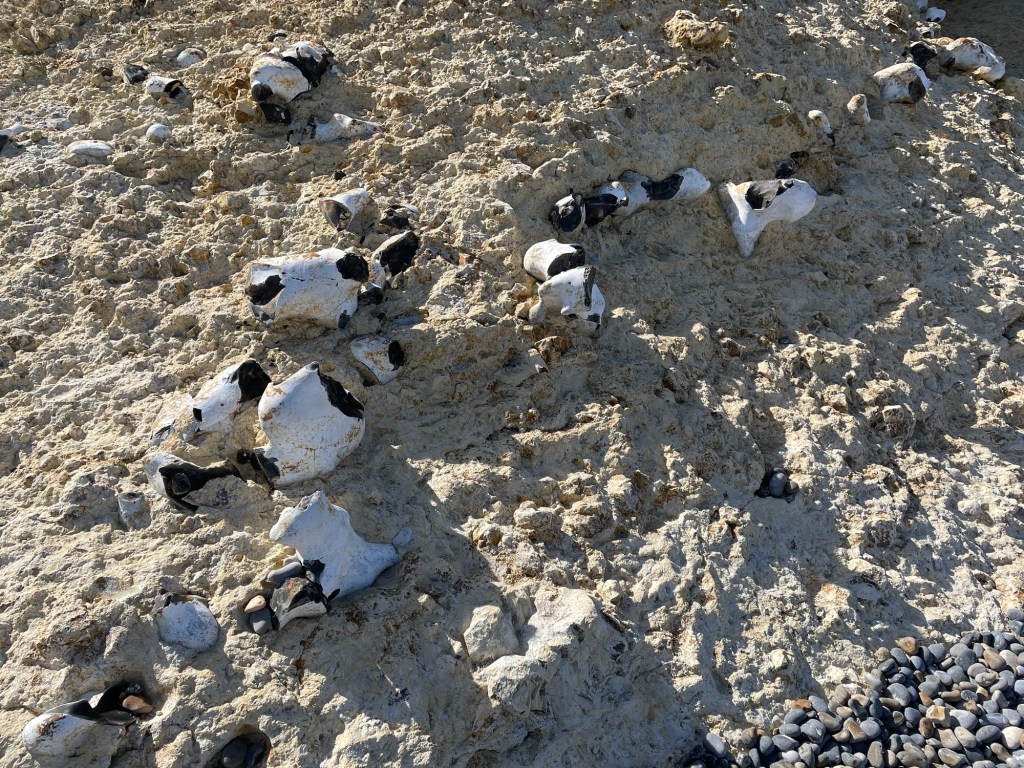
A seam of large flints lined one area of the cliff. I remembered this detail from my walk in 2020.  As it erodes, the cliff is gradually letting go of these ancient fossil forms. A few are now freed to move with the tide and begin to be rounded, reduced and ground down to pebbles.
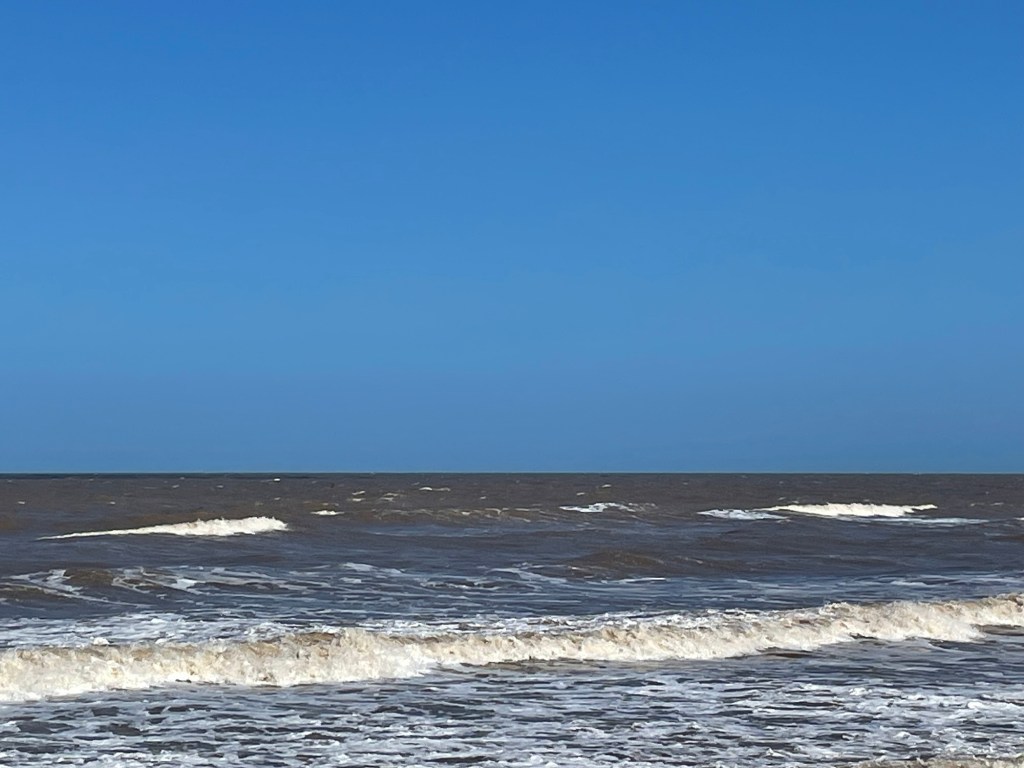
I pressed on with the Sun to my left and the sea my right. Signs of humanity were few. A piece of foil packaging, high on the beach, tumbled by, flashing bright reflections as it went. Out in the troughs and peaks of the waves, fishing marker buoys danced. A rusting catering size tin can, once holding tomatoes, was embedded near the high water mark. Out to sea, a yacht at anchor, with mast laid down, bobbed about in the choppy conditions. On the horizon, maybe one merchant vessel, then the two vast fields of wind turbines, wheeling steadily away.
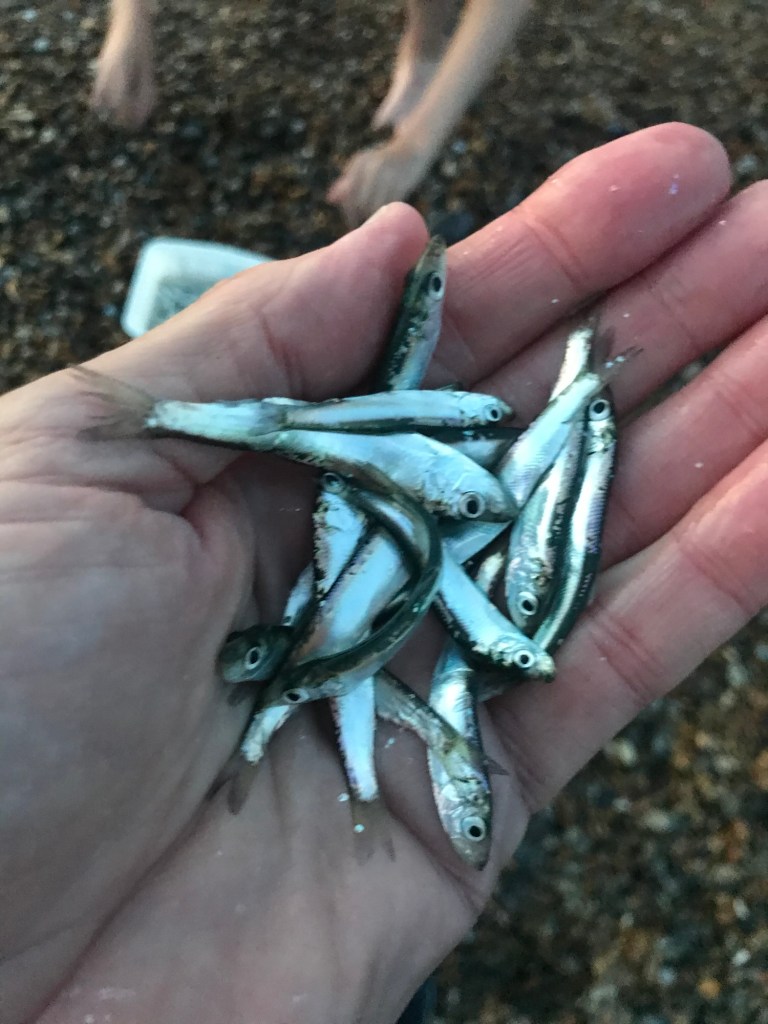
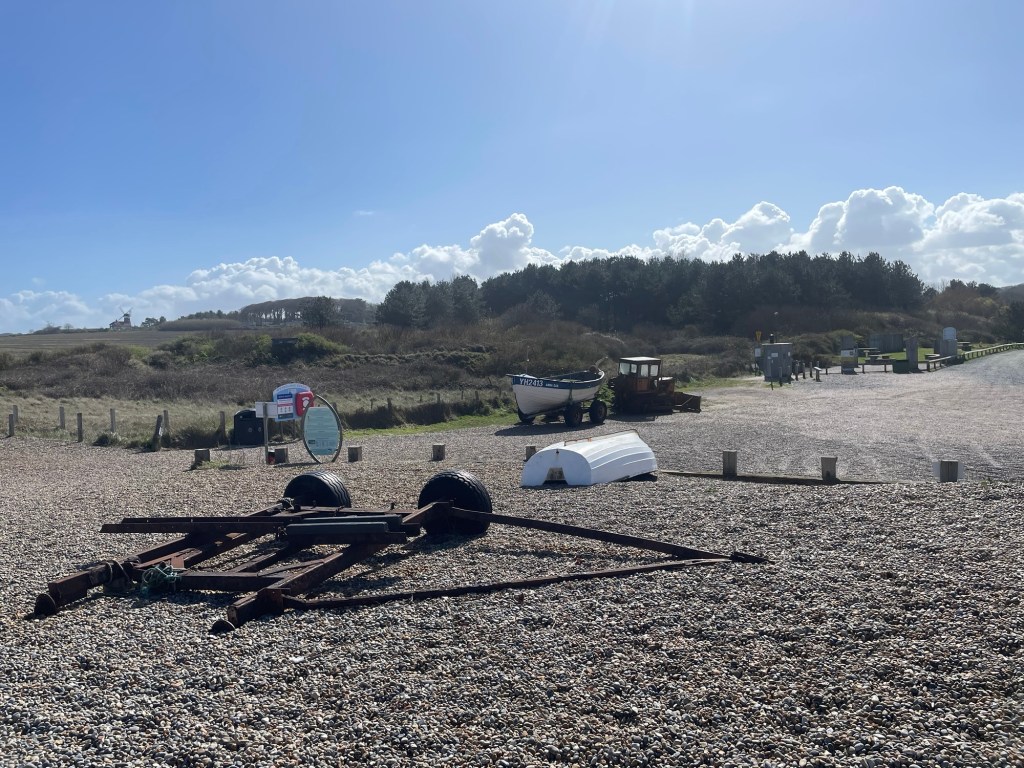
Commercial fishing takes place from Weybourne. Along this stretch of coast crusty tractors are used to pull boats out to sea and from the water. Lobster and crabs are the basis of the industry. Mackerel and Bass are caught in good numbers here too. It is possible to lift whitebait by the handful from tideline pools along the shoreline in summer.
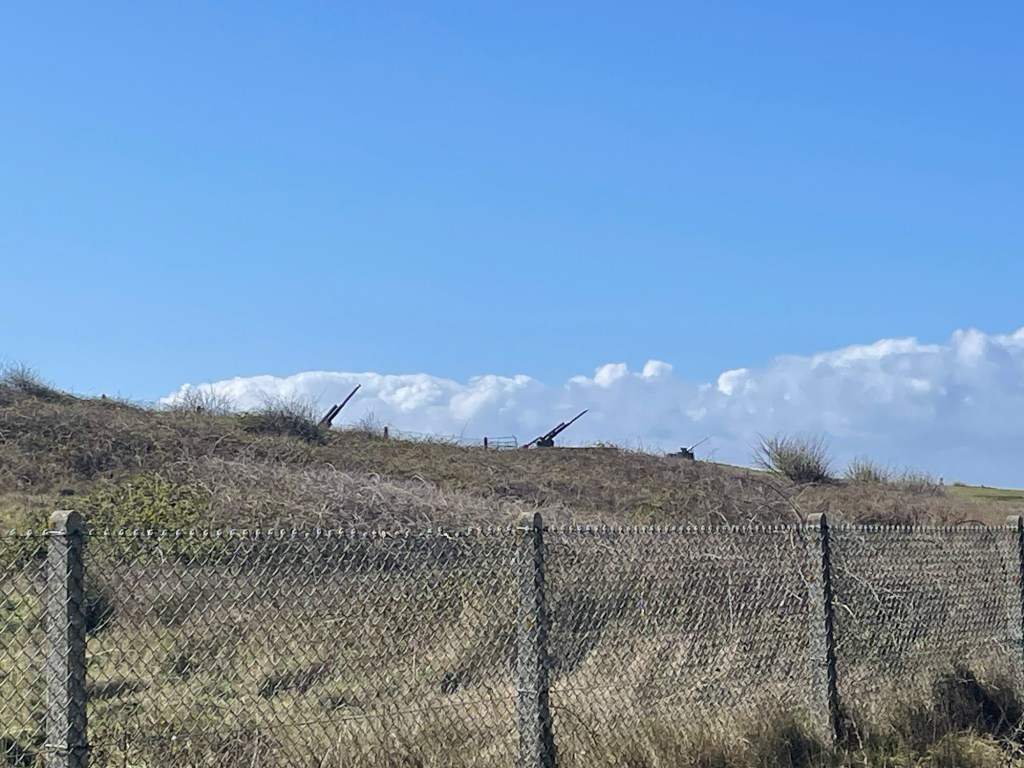
Moving onto easier terrain, I passed the military museum, with its anti-aircraft battery pointing out to sea. I know these are relics of the war with Nazi Germany, but I am always made conscious of the current threat from further East. I do not enjoy walking past this museum.
Turning inland I was now on very familiar territory. This is where I spent the initial months of the pandemic. I am on the path of my regular, singular circuit bounding the salt marshes, reed beds and shallow pools inhabited by waders, ducks, swans and geese. On the field where I saw Mad March Hares boxing six years ago, there was no sign of them today.

I passed a woman heading toward the beach, who made a light complaint about the cold wind in a West Midlands accent. I was surprised by a rotund, elder couple, sat low on a bank eating a sandwich lunch. They were well dressed for walking in these conditions and were in good spirits.
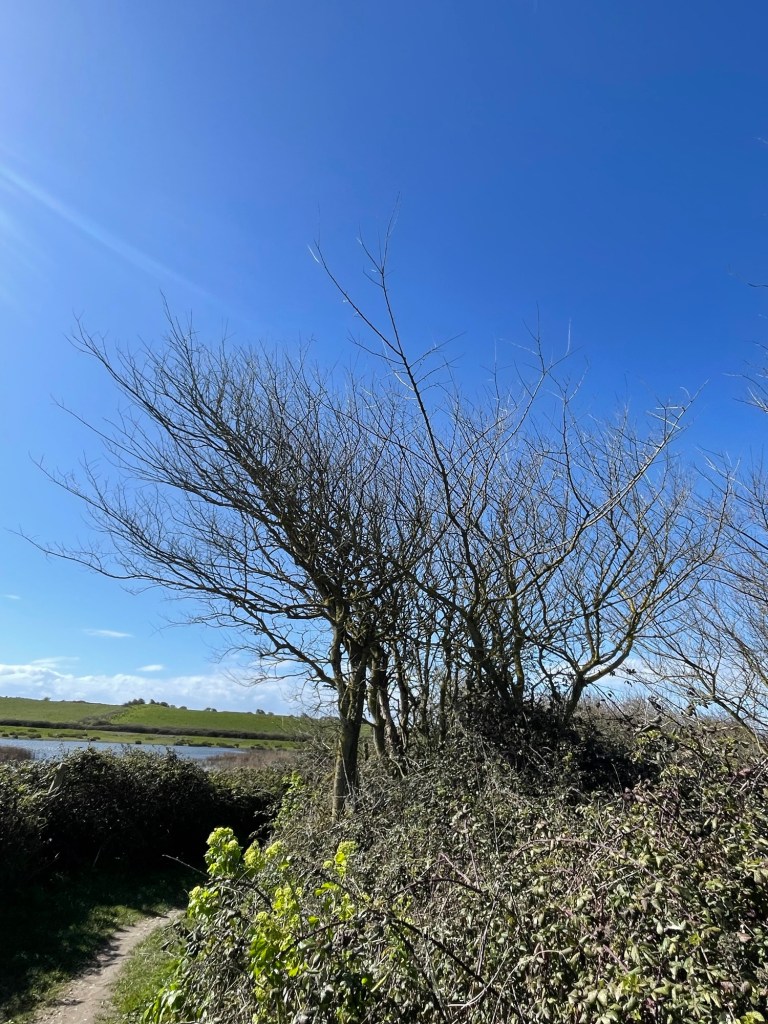
I noticed how late the blossom begins here, the hawthorn barely visible. The wind bent, stunted tree pointed inland, limbs still without leaf. More swans and a pair of teal at the pond by the coast road, a few gulls, a pair of mallards. Some indeterminate chirping came from hedge and bushes.
Reeds bowed and rattled in the breeze by the bus stop. The tweeting and whistling Starlings began to collect on a telephone wire. Showers traced a path along the horizon towards Cromer. It was time to head home.
 Journey of Words
Leave a comment